We are extremely honored to continue the series of Pharma Industry’s Perspectives on Serialisation by having with us Mrs. Anca Crupariu, Pharmacists Professional Organisation’s Spokesperson, who outlined the benefits of the Falsified Medicines Directive implementation:
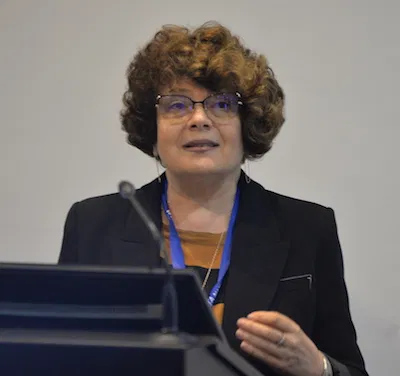
“To understand the importance of implementing the so-called Falsified Medicines Directive (Directive 2011/62/EU) we should begin with the definition of the falsified medicinal product, introduced by this Directive, namely:
- any medicinal product with a false representation of:
- its identity, including its packaging and labelling, its name or its composition as regards any of the ingredients, including excipients and the strength of those ingredients;
- its source, including its manufacturer, its country of manufacturing, its country of origin or its marketing authorization holder; or
- its history, including the records and documents relating to the distribution channels used.
It goes without saying that in the case of a falsified medicine, there is a risk of therapeutic ineffectiveness due to ingredients – active substances and excipients – of inadequate quality in accordance with the strict standards imposed by the European Union (EU) legislation, or lack of active substance, but even the risk of possible adverse health effects. The internet has proven to be, so many times, a real jungle in which it is extremely difficult, even for the competent entities, to detect falsified medicines in time. This is why the EU medicines’ regulatory and control authorities, scientifically coordinated by the European Medicines Agency (EMA) constantly send messages urging the public, the patients not to purchase medicines on the Internet, but only from authorized units, because there is a great risk of buying a falsified product.
The number and frequency of previous cases of falsified medicines reported in the EU and the evolution of the number and frequency of such cases up to when the European Directive has been issued in 2011, have made is necessary to adopt a normative act, which, transposed into each EU member state’s national law, to prevent falsified medicines from entering the legal supply chain. The Falsified Medicines Directive amended and supplemented, in this respect, Directive 2001/83/EC establishing the Community code related to medicinal products for human use.
The process of implementing the European Directive, until the deadline of February 9th, 2019, was a successful one, through the efforts of the pharmaceutical industry and the work in close collaboration – within the Working Groups set up by the Romanian Medicines Serialisation Organisation (OSMR) – of the authorities’ representatives: The Ministry of Health, The Romanian National Agency for Medicines and Medical Devices (ANMDMR), The National Health Insurance House (CNAS), together with the stakeholders’ representatives, directly involved in the implementation of safety elements on the medicines’ packaging (marketing authorization holders – MAHs, community and hospital pharmacies, healthcare institutions, wholesalers and parallel importers).
February 9th, 2019, was the date of the European Medicines Verification System (EMVS) go-live, respectively the national implementation of the National Medicines Verification System (NMVS), verification platform through which pharmacies, as End-Users of the system, can verify the authenticity of a product and ultimately, to decommission it.
February 9th, 2019, marked the date when the pharmacists’ community faced a new challenge in their daily activities, which they are handling with great responsibility. For every pharmacy this meant providing the working points with scanners and updating the internal software applications in order to connect to the NMVS. The next step consisted of registering the pharmacy in the NMVS so as to ensure compliance in terms of authenticity and legitimacy of the respective organization. The decommissioning transaction takes approximately 0,3 seconds. It is quite remarkable that in such a short period of time, that goes unnoticed in our normal day to day existence, data is verified in a national system, allowing the pharmacists to have the certainty that the medicine pack that they are handing the patient is an authentic one.
Patients should be aware of the dangers of purchasing medicines online! There is an increasing number of websites that offer medicines which, in many cases, are not the ones for which the authorities in the field have issued marketing authorisations. This is why the Falsified Medicines Directive has introduced a EU-wide logo which allows those interested in purchasing in this manner to identify pharmacies authorized to sell medicines online, ensuring thus that the medicines purchased this way are authentic. On the Ministry of Health’s website (https://www.ms.ro/pacienti/#tab-id-4), one can find the list of pharmaceutical units (pharmacies and drugstores) authorized for online marketing, according to the law, only for medicines which can be released without a medical prescription.
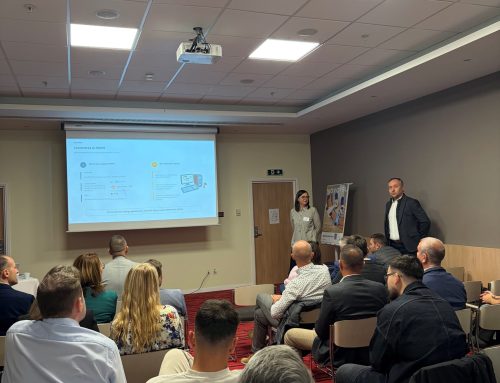
On February 9th, 2018, I took part in the event organized by OSMR, so suggestively named PATIENT SAFETY THROUGH MEDICINE SAFETY, date on which the national medicines serialisation project was publicly launched. One year before the NMVS became operational, all the event’s participants, representatives of all parties to be involved in the implementation of the new way of identifying and protecting medicines against illicit changes, understood the importance of the moment and the obligations to be undertaken. The success of the project depended on combining the work of all the links in the supply chain.
It is my duty to emphasize that pharmacists have been committed to implementing the serialisation project with professionalism and dedication, understanding the importance of OSMR’s initial message to all stakeholders, regardless of their place in the distribution chain, namely to ensure PATIENT SAFETY THROUGH MEDICINE SAFETY!”