How easy is it to spot a falsified medicine? This is nearly impossible just by looking at the medicine itself or at its packaging.
The patient is facing dangers ranging from lack of effect of the respective medicine, more precisely therapeutic ineffectiveness due to ingredients – active substances and excipients – of inadequate quality, or lack of active substance, to drug resistance which enables disease progression or even the risk of possible adverse health effects.
Both the innovative medicines industry, as well as the generic medicines industry are targeted by the falsified medicines market.
According to the European Medicines Agency (EMA), in developed countries, the medicines that were frequently falsified were expensive “lifestyle” medicines, like for example: hormones, steroids and antihistamines. In recent years, the falsified medicines market has grown, encompassing an increasing number of products, including expensive anticancer or highly in demand medicines, such as antivirals (source: EMA).
Here comes the big change entailed by the implementation of the Falsified Medicines Directive at European level: detecting a falsified medicine is no longer an impossible task, but it becomes a reality.
Starting with February 9th, 2019, safety elements – the Unique Identifier, encoded in the 2D Data Matrix code, and the anti-tempering device – have been placed on medicine packs, bringing a visible change to the layout of the packaging, playing thus an essential role in protecting patients’ safety.
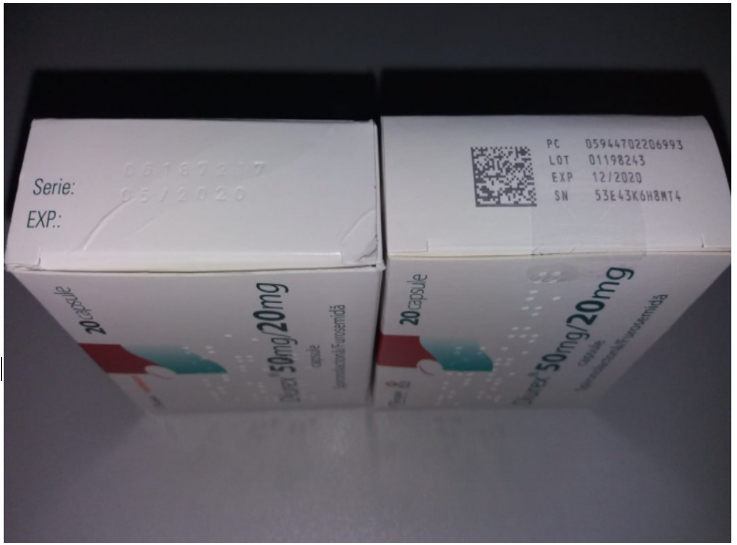
In the image above – medicine package prior to 09.02.2019 on the felt-hand side, medicine pack after 09.02.2019 on the right-hand side
According to the Commission Delegated Regulation (EU) 2016/161, the verification of the authenticity of the Unique Identifier aims at ensuring that the medicinal product originates from the legitimate manufacturer, whilst the verification of the integrity of the anti-tempering device shows whether the packaging has been opened or altered since it left the manufacturer, thereby ensuring that its content is authentic.
The data elements of the Unique Identifier are: Product Code (a code allowing the identification of at least the name, the common name, the pharmaceutical form, the strength, the pack size and the pack type of that medicinal product), Serial Number (a numeric or alphanumeric sequence of maximum 20 characters, generated by a deterministic or a non-deterministic randomisation algorithm), Batch Number, Expiry Date and National Reimbursement Number (if required by the Member State where the product is intended to be placed on the market).
The implementation of the Falsified Medicines Directive proves that patient safety is a top priority at the European level and the national success of this unique project comes from an open communication and fruitful cooperation between the National Competent Authorities, the blue-print provider: Arvato Systems GmbH and the stakeholders directly involved in this endeavor: MAHs (marketing authorization holders), community and hospital pharmacies, healthcare institutions, wholesalers, parallel importers and software suppliers.