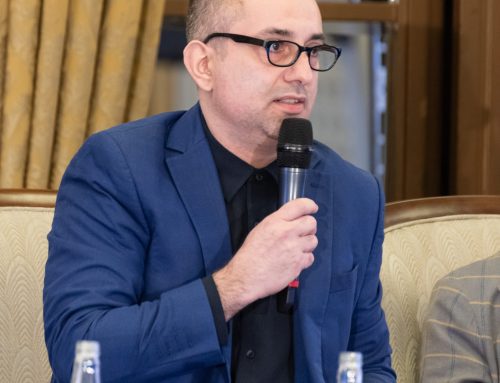
Ms. Coralia Kreyer, member of the OSMR Board of Directors, President of the Association of European Medicines Distributors (ADEM) in Romania, shares her perspective on the Serialisation Project.

1. What has been the biggest challenge that serialisation brought to the industry you are representing?
Starting with February 2019, compliance with the provisions of the Falsified Medicines Directive has been a priority for the parallel distribution sector (inter-community trade), represented in Romania by the Association of European Medicines Distributors (ADEM), as well as for the pharmaceutical industry, pharmaceutical distribution and retail operators and pharmacists (ARPIM, APMGR, ADRFR and CFR), all founders of OSMR. Our mission, of all those involved, is to protect the legal supply chain against the entry of falsified medicines.
The commitment of parallel distributors in Romania to ensure patient safety is visible by integrating and fulfilling the responsibilities that have resulted from the implementation of the serialisation project. Parallel imported medicines have marketing authorisations from authorised wholesalers or manufacturers authorised in the EU/EEA (European Economic Area) and must bear on their packaging both the unique identifiers (two-dimensional barcodes) and the anti-tempering devices, like all the other medicines.
Thus, in order to comply with the new regulations on medicines’ serialisation, parallel distributors have the obligation to decommission packages received from other EU/EEA countries and subsequently, through manufacturers performing repackaging/relabelling operations, remove and cover, partially or totally, the safety features of these medicines, replacing them with equivalent ones, which comply with the rules in place.
These new tasks, meaning connecting to the European Hub and the National Medicines Verification System, maintaining the original condition of the medicine pack, the expiration date of the product, the addition of a new distribution market in the system represented a challenge that the industry successfully completed.
2. What is in your opinion the biggest advantage that the Falsified Medicines Directive (FMD) has to offer?
February 9th, 2019, marked the entry into force of the Falsified Medicines Directive. Thus, starting with this date, medicines subject to prescription must bear the safety features: a unique identifier and an anti-tampering device, ensuring patients’ access to authentic medicines.
The serialisation project is of extreme importance not just at national level, but also at European level, because the main objective, that of placing patients’ safety in the forefront, has been a priority for all European countries.
3. What have been the major concerns expressed by members within the industry you represent?
Taking into consideration the complexity and the novelty elements that the serialisation project has brought in the daily activity of all the actors involved, a major concern has been the one related to the repackaging/relabelling process. This is a process that requires time and a lot of effort and in the current conditions even more attention so as not to generate alerts in the National Medicines Verification System (NMVS).
Moreover, the parallel distributors members of ADEM have made considerable efforts in recent years to minimise the impact of certain medicines’ shortages and in this context, the major concern has been not only of finding these medicines in the European distribution and importing them, but also of carrying out these actions in a short amount of time, to respond to the National Competent Authorities requests and the critical needs of the Romanian patients.
4. What are some of the dangers associated with medicines falsification?
Obviously the greatest danger when we talk about falsified medicines, refers to the risk they pose to the patients’ health, both in the short and long term.
The increasing access and use of the internet makes it easier to distribute drugs illegally and on a large scale. There are countless websites that offer medicines – many of which trade illegally and without the involvement of a medical professional. The supplied medicines are highly unlikely to be the authorised versions.
At the same time, the inability to access or to afford certain medicines are among the reasons why some patients resort to illegal options, like for example illegal dealers or online distributors, thus endangering their health.
The Falsified Medicines Directive has introduced a measure for this type of situation, namely a common, EU-wide logo to identify legal online pharmacies, ensuring that the medicines supplied in this way are authentic.
The difference between the original and the falsified packaging is usually very subtle, but parallel importers have experts who meticulously compare imported medicines with the original information provided by the marketing authorisation holder. Because of their experience in repackaging and relabelling, parallel distributors are frequently able to eliminate suspicious packages, which may harm patients, before being placed on the market, reporting to the National Competent Authorities any suspicion of counterfeit.
5. What are the most valuable lessons learned that can be taken by the industry from the serialisation experience so far?
The implementation of the serialisation project meant first of all an efficient collaboration between the stakeholders, both at national and at European level.
We are talking about an example of a successfully implemented project, when the novelty elements represented a challenge for all those involved in providing authentic medicines to patients.
We witnessed the creation of a collaborative environment, which based on the understanding of the needs of each party involved in the process, contributed to the integration of the new notions.